
Urologic Robotic Surgery
- Prostate cancer
- Kidney cancer
- Kidney obstruction
- Kidney, ureter, and bladder reconstruction
- Prostate removal for BPH
Robotic Surgery at UC Davis Health
The state-of-art robotic surgery program at UC Davis Health has an experienced and highly trained team of surgeons, nurses and technicians. Our specialists are trained in robotic-assisted surgery for urological conditions and perform dozens of procedures each month using the da Vinci® surgical system.
Robotic-assisted surgery is a leading edge technology. Because it is minimally invasive, the precision of robotic technology is ideal for delicate and complex urologic surgeries. These include prostatectomies, in which the target site is tightly confined and surrounded by nerves affecting urinary control and erectile function. Surgeons using a robotic system have an exacting tool for avoiding damage to surrounding nerves and helping enhance recovery times and the return to normal activities.
Robotic-assisted surgery provides similar benefits in children, including shorter recovery time and improved cosmesis. Common upper urinary tract disorders including ureteropelvic junction obstruction and obstructed upper pole moiety in a duplex kidney may be approached robotically. Complex reconstructions for congenital abnormalities of internal reproductive organs may also be managed with robotic surgery. Procedures include robotic pyeloplasty and ureteroureterostomy.
Benefits to patients
Robotic surgery enables surgeons to perform a more precise operation than conventional surgery. It offers several potential benefits over a conventional open surgery, including:
- Significantly less pain
- Less blood loss
- Less risk of infection
- Less scarring
- Shorter hospital stay
- Quicker recovery time
- Better clinical outcomes in many cases
As with any surgical procedure, benefits cannot be guaranteed. Successful outcomes depend on the procedure and the patient.
Robotic-assisted surgery
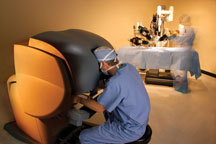 During the operative procedure the surgeon sits at a controlling console near the patient. An assistant surgeon is at the bedside next to the patient. Through a video camera, the surgeon watches the operative field and controls several robotic arms from the console which replicate the surgeon’s movements. The operating robot has several advantages over standard surgical techniques because it combines the precision and accuracy of a machine with the judgment of an experienced surgeon.
Benefits to the patient from surgery include length of recovery time. The operation is performed laparoscopically, meaning it is less invasive because it requires small punctures rather than a large incision. That means less time is required to heal. Most patients return to normal activity in 2-to-3 weeks instead of the 6-to-8 weeks common to standard open surgery. There also is less blood loss during a robotic surgery, resulting in a higher blood count. A higher blood count provides for quicker return of strength and stamina after surgery.
Robotic Surgeons

Noah E. Canvasser, M.D.
Endourology and Minimally Invasive Surgery

Marc A. Dall'Era, M.D.
Urologic Surgical Oncology

Thenappan Chandrasekar, M.D.
Urologic Surgical Oncology

Philip Hsiao, M.D.
Urologic Surgical Oncology