Quantcast

Trauma Prevention and Outreach

Buckle up to grow up: one step at a time

Motor vehicle crashes are the leading cause of death and injuries to children. The correct use of child safety seats can dramatically reduce serious injuries.

Remember, California law requires children under age 6 or weighing less than 60 pounds to ride in the back seat of a vehicle in a car seat or booster seat.

This booklet is designed to help you select the proper child restraint system for your child. The best and safest seat is one that fits your child, fits your vehicle and is easy to adjust, so you can do it correctly every single time. Always follow the child safety seat manufacturer’s instructions and the vehicle’s instructions to ensure the seat is being used properly.  Download this booklet in PDF format to print or view.

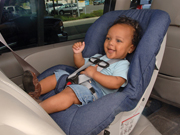
Step 1: Rear-facing newborn to at least 1 year old AND up to at least 20 pounds

For step 1, choose a child safety seat from these types:  
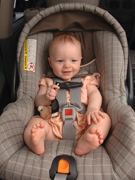
  • Infant child safety seat used rear-facing only.
  • Convertible child safety seat that can be used rear-facing and forward-facing.

Safety tips

  • At a minimum, infants must ride rear-facing until age 1 and up to at least 20 pounds. The American Academy of Pediatrics recommends that babies ride rear-facing in a convertible seat to the maximum rear-facing limit of the seat, which is usually around
    30 pounds.
  • The harness straps in the child safety seat are passed through the openings at or just below the top of the baby’s shoulders.
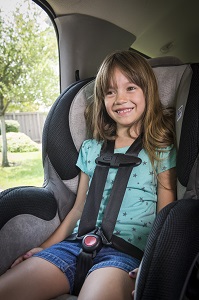
  • Harness straps must lie flat and fit snug. Pinch the harness at the shoulder; there should be no slack.
  • Harness chest clip secured at armpit or nipple level.
  • Secure the child safety seat in the back seat facing the rear of the vehicle. Never use a rear-facing child safety seat in the front seat where an air bag is present.
  • A rear-facing child safety seat should recline at approximately a 45-degree angle so the baby’s head does not flop forward.

Step 2: Forward-facing – children at least 1 year old AND over 20 pounds

For step 2, choose a child safety seat from these types:
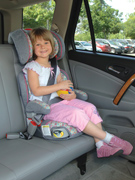
  • Convertible child safety seat that can be used forward- and rear-facing.
  • Forward-facing only child safety seat with harness for children 20-80 pounds.
  • Combination child safety seats that can be used with harness for children 20-40 pounds. At 40 pounds, remove the harness and use with vehicle’s lap and shoulder belt.

Safety tips

  • When children are over 1 year of age and over 20 pounds, they can use a forward-facing child safety seat. The American Academy of Pediatrics recommends that babies ride rear-facing in a convertible seat to the maximum rear-facing limit of the seat, which
    is usually around 30 pounds.
  • The harness straps in the child safety seat are passed through the openings close to or just above the top of the child’s shoulders. In most convertible seats, the top opening must be used when child is forward-facing. However, on forward-facing only seats or combination seats, any opening can be used that is at or above the child’s shoulders. Always check the manufacturer’s instructions.
  • Harness straps must lie flat and fit snug. Pinch the harness at the shoulder; there should be no slack.
  • Harness chest clip secured at armpit or nipple level.
  • Secure the child safety seat in the back seat of the vehicle.
  • Child safety seat should be in the upright position. Check the manufacturer’s instructions. Some seats are allowed to recline in the forward-facing position.

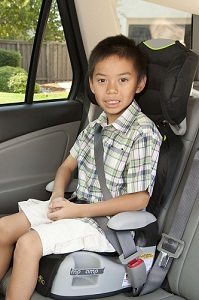
Step 3: Belt-positioning booster seats – children over 40 pounds

For step 3, choose a child safety seat from these types:

  • Combination seat – using lap shoulder belt and internal harness removed.
  • High-back booster seat – must be used when a vehicle does not have a
    head restraint.
  • Backless booster seat – can be used when a vehicle has a head restraint.

Safety tips

  • Children are ready to use a booster seat when they weigh 40 pounds or have outgrown their five-point harness. Some child safety seats have a harness weight limit beyond 40 pounds. It is preferable to continue using the five-point harness until your child reaches that weight limit or has outgrown the seat.
  • Must be used with lap and shoulder belt.
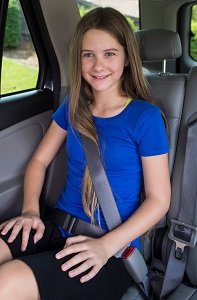
  • Shoulder belt fits snugly across chest and rests on the shoulder.
  • Lap belt lies snugly across the upper thighs and below the hips.
  • Secure the booster seat in the back seat of the vehicle.
  • When child is not in the booster seat, secure the booster with the seat belt to ensure the loose seat does not cause injury.
  • Manufacturer’s weight and height limits vary. Minimum weights vary from 30-40 pounds and maximum weights vary from 80-110 pounds. Height limits vary from a minimum of 37 inches to maximum 59 inches. Be sure to follow instructions.

Always follow the car seat manufacturer’s instructions and the vehicle’s instructions to ensure seat is being used properly.

Step 4: Seat belts – children over 4'9" tall

Facts

  • Seat belts are designed to fit adults, not children.
  • A lap belt sitting across the stomach can cause serious damage to the child’s internal organs and spine during a crash.
  • If the shoulder belt is not sitting snugly across the mid-chest and resting on the shoulder during a crash, serious injuries to the brain, face and spine can occur.

For step 4, be sure your child meets the following guidelines:
  • Child can sit back with his/her back against the vehicle seat back.
  • Child’s knees are bent over the edge of the vehicle seat.
  • Lap belt lies snugly across the upper thighs and below the hips, and the shoulder belt
    lies snugly against the chest and rests on the shoulder.
  • Usually when the child is 4'9" tall.
  • All children under 13 years old should ride in the back seat.

When choosing a child safety seat, remember

  • The best and safest seat is one that fits your child, fits your vehicle and is easy to adjust, so you can do it correctly every single time.
  • Choose a child safety seat that is the right size for your child. Check the manufacturer’s instructions for weight limits.
  • Before you purchase a child safety seat, try locking and releasing the buckle. Try adjusting the harness. Is the adjuster easy to use? Make sure the adjuster is in a position that is easy to reach and operate when the child safety seat is secured in the vehicle.
  • Try the child safety seat in your vehicle. Some safety seats fit in some vehicles better than others. Choose the seat that fits tightly in your vehicle. Read your vehicle owner’s manual and the safety seat instructions.
  • All new child safety seats come with a registration card. On the card is the model number of your seat and the date it was manufactured. Fill this card out and register it with the manufacturer so that you can be notified of any safety recalls.
  • A child safety seat that is more than six years old should be replaced. Most seats have an expiration date on the shell. Normal wear and tear may cause the seat not to work as well as it did when it was new.
  • Avoid using a secondhand child safety seat, especially if it was bought from a yard sale or a thrift shop, because you won’t know the seat’s history.
  •  If you have problems with your child safety seat or want to report a defect, contact the manufacturer as well as the National Highway Traffic Safety Administration Auto Safety Hotline at (888) 327-4236.

Installation tips

  • Never secure a rear-facing baby in the front seat of a vehicle with a passenger-side air bag. Children 12 and under should not be seated next to an air bag. The back seat is generally the safest place for a child of any age.
  • Make sure the child safety seat is facing the right direction for your child’s age and size.
  • Check and make sure the seat belt or LATCH system is routed through the correct belt path on the child safety seat.
  • If you are using the LATCH system to attach the seat, follow the vehicle’s instructions to make sure you have attached the straps to the correct anchor points in the vehicle.
  • Be sure that the LATCH straps or seat belt is holding the child safety seat tightly. To help get a tight fit, put your body weight into the child safety seat while tightening the seat belt or LATCH. If you can move the seat more than an inch side to side or front to back, it’s not tight enough.
  • Most vehicles manufactured after 1996 provide seat belts that can secure child restraints tightly. Older vehicles may require the use of a locking clip. Read the child restraint instructions as well as the vehicle instructions before beginning installation.
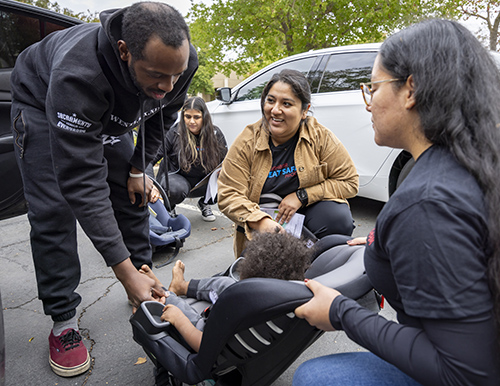
  • Get your child safety seats checked to make sure it is installed properly. To find a child passenger safety technician in your area, contact the National Highway Traffic Safety Administration.

The simple facts about LATCH (Lower Anchors and Tethers for Children)

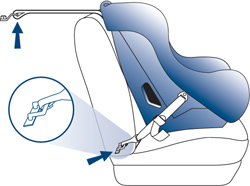
  • LATCH is a system that makes child safety seat installation easier – without using seat belts. LATCH is required on most child safety seats and vehicles manufactured after Sept. 1, 2002.

  • LATCH is not required for booster seats, car beds and vests.
  • Attachments on a LATCH-equipped child safety seat fasten to anchors in a LATCH-equipped vehicle.
  • Most LATCH-equipped vehicles have anchors in the right and left rear seat positions. If the center seat doesn’t have anchors, you can still install your child safety seat using a seat belt.
  • If your vehicle isn’t LATCH-equipped, use the seat belt and, if available, a top tether.
  • If your child safety seat isn’t LATCH-equipped, it’s still safe if it has been correctly installed using a seat belt, hasn’t been recalled and hasn’t been damaged.
  • For correct installation and use of ALL child safety seats, ALWAYS follow your vehicle owner’s manual and child safety seat manufacturer’s instructions.

UC Davis injury prevention child passenger safety program

Our mission is to decrease preventable childhood deaths and injuries through research, education and community outreach.

Our program offers:

  • Child safety seat inspections by appointment
  • Multilingual car seat classes to the public
  • Child passenger safety education for health care workers
  • National child passenger safety technician training
  • Multilingual child passenger safety materials
  • Community child safety seat inspection events
  • Child safety seat resources for low income families

For more information on our child passenger safety program or other information on injury prevention, please call:

Location:

Trauma Prevention and Outreach Program

Mailing address:

4900 Broadway, Suite 1650
Sacramento, CA 95820

Phone:

(916) 734-9799

Fax:

(916) 734-9417