What to Expect
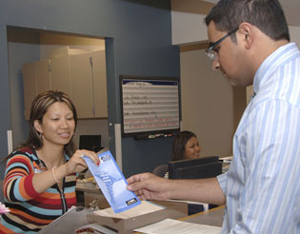 The UC Davis Health System Eye Center welcomes the opportunity to participate in your eye care. We want your experience to be as pleasant and comfortable as possible. To help achieve this, we ask you read through and be aware of the following information.
Please note: Not all patients will have the same experience. Use the following information as a guide only.
Medical Records
When seeing one of our ophthalmologists for the first time, it is often helpful for them to review your past medical records from other offices you may have visited. Examples of past ophthalmic records may be photography, fluorescein angiograms, or visual fields. Please also bring records of previous surgeries or other eye exams. If you are scheduled to see a neuro-ophthalmologist, we ask that you hand-carry MRI/CT films and clinic notes to our office.
Examination
The examination and treatment that you receive at the UC Davis Health System Eye Center might be different from previous eye examinations you may have had. We provide a highly specialized ophthalmic examination that can last several hours. At the UC Davis Health System Eye Center, tests may be performed that are not routinely done at other eye physicians’ offices. Patients that are new to the eye center or new to a particular subspecialty should expect to spend 4-5 hours during a visit. Rest assured, we take these steps to provide you with the best possible diagnosis and treatment of your eye condition.
Dilation
Most new patients will have their pupils dilated during a visit to the eye center. Dilation is a necessity for a thorough evaluation of your eyes. Usually, an ophthalmic technician will administer drops in the eye(s) to be examined and the pupil will become fully dilated in about 30-45 minutes. Dilation will cause your vision to become blurry and light will appear to be brighter than usual. Patients should plan on bringing sunglasses to their appointment. If you are concerned about driving while dilated, please bring someone to drive you home. Pupils can remain dilated for up to 24 hours.
Contact Lens Fitting
The cost of contact lens fitting services is separate and distinct from the exam fees you are charged by the UC Davis Health System Eye Center. The contact lens prescription will include very specific information that is not determined or provided during a regular eye exam that is performed by your doctor. Please also note that these services may require multiple office visits. A contact lens fitting takes longer than a regular eye exam, so please allow yourself plenty of time. When making an appointment, be sure to let the office know that you need a contact lens fitting not just a regular eye examination.
Medical Records
When seeing one of our ophthalmologists for the first time, it is often helpful for them to review your past medical records from other offices you may have visited. Examples of past ophthalmic records may be photography, fluorescein angiograms, or visual fields. Please also bring records of previous surgeries or other eye exams. If you are scheduled to see a neuro-ophthalmologist, we ask that you hand-carry MRI/CT films and clinic notes to our office.
Professionals you might encounter during your exam
The ophthalmic technician is usually the first person a patient encounters after check-in. Our technicians have received specialized training in various ophthalmic procedures such as assessing a person’s vision, performing various tests such as visual fields, measuring intraocular pressure, and administering vision color tests.
An ophthalmologist is a medical doctor (M.D.) and surgeon who has completed medical school, an internship, and a residency in ophthalmology. You may see an ophthalmologist who specializes in various specialties such as cornea, glaucoma, or retina.
A resident is a licensed doctor of medicine and surgery in the state of California. Residents have completed medical school and an internship in medicine and are now obtaining specialized training in ophthalmology. A resident is typically enrolled on our training program for three years.
A fellow is a licensed physician and residency trained ophthalmologist, now obtaining subspecialty training in retina, glaucoma, or cornea. A fellow is typically enrolled in our program for one to two years depending on the specialty.
An optometrist (O.D.) is a primary eye care provider who diagnoses, manages, and treats disorders of the visual system. Typically, one would see an optometrist for an eyeglass prescription. During the exam, the optometrist will evaluate the overall health of the eye and if the need arises may refer you to a subspecialist physician within our practice. O.D.s must complete four years of postgraduate optometry school for their training.
An ophthalmic imaging specialist is an individual who has received specialized training in ophthalmic imaging procedures such as fluorescein angiography, fundus photography, optical coherence tomography (OCT), and ultrasound. Not all patients will require imaging at their appointment.
An optician is a person trained in the selection, manufacture, and dispensing of eye glasses and contact lenses. The American Board of Opticianry tests and certifies opticians.