
Program Structure
Goal
The goal of the general surgery training program is to train individuals in the art and science of surgery and to cultivate the next generation of leaders in surgery.
Overall Description
Here at the Department of Surgery, we are committed to the residents we match. This includes fostering an environment rich in diversity, innovation and continuous learning, and with providing each resident the opportunity to achieve their specific career goals. Our residency program includes five clinical years of postgraduate training at University of California, Davis Medical Center in Sacramento California with 6 affiliated hospitals. A special feature of our program is the option for taking 1-2 years of fully funded academic enhancement/research time after the third clinical year.
The goals and expectations of the educational program are distinct for each clinical year. The PGY-1 year provides an introduction to the broad discipline of general surgery, focusing on peri-operative care offered in two tracks: categorical and preliminary. There are 9 categorical positions – 2 are filled in the military match and 7 are filled through the NRMP Match. There is a variable number of preliminary positions available each year. In a typical year, there are 10 – 12 preliminary PGY-1 residents from the US Air Force and 4 or 5 civilian preliminary PGY-1 residents. The civilian positions are filled through the NRMP Match. Categorical residents are assured steady progress through the 5 clinical years in the program, provided they meet predetermined guidelines set by the department. The preliminary positions are 1-year long. Regardless of categorical or preliminary status, all residents are afforded the same educational opportunities and are held to the same standard.
Our goal is to create an environment where every resident succeeds. Our commitment and passion drives everything we do, and we seek to cultivate that passion in our residents. With this in mind, we have created Career Development Experiences for residents interested in the areas of Surgeon/Scientist, International/Rural Surgery, Public Policy/Comparative Effectiveness and Surgical Education. Residents in the program also go through a seminar series, Residents as Teachers and Leaders, aimed at teaching the skills necessary to teach medical students / junior residents and to lead clinical and administrative teams while in training and beyond. We have a strong history of being at the forefront of surgical innovation and training and this tradition continues each year with our residency programs.
Highlights:
- Nine categorical positions are available each year, including 1-2 categorical positions offered in conjunction with the US Air Force.
- 10-13 preliminary PGY-1 positions are offered each year for active duty Air Force physicians designated in the Pre Flight Surgery Surgical Training Track.
- One to four civilian preliminary positions are offered each year through the match
- Research is encouraged throughout the entire residency. There is time allotted between the clinical PGY-3 and PGY-4 clinical years for residents to pursue their interest in research or academic endeavors. This time is not required but most residents take time for career development.
- Funding is provided by the Department of Surgery for at least the first year of research or career development
The first distinction of our program is the diversity of clinical training. The centerpiece of the program is UC Davis Medical Center, a tertiary referral center for Northern California. The surgical care at the university includes trauma, acute care surgery, surgical critical care, vascular, surgical oncology, transplant, pediatric, burns and general surgery, including minimally invasive, bariatrics and robotic surgery. The clinical experience at the University is augmented by our robust outside rotations in all clinical settings (private practice, HMO, military, VA, and charitable care).
Second is the research excellence at UC Davis and within the Department of Surgery. Cutting edge surgical research augments the clinical aspects of our training program. Many of the faculty in the department are funded and welcome resident participation in their research. Residents are able to take advantage of the UC Davis Institute for Regenerative Cures, the William R. Prichard Veterinary Medical Teaching Hospital at UC Davis, the Clinical Investigation Facility at Travis AFB, and the UC Davis Center for Healthcare Policy and Research. Projects encompassing both clinical and basic science research are designed to better prepare our residents for fellowships, academic or private practice.
We augment our educational environment by providing specific training to our residents in the basics of adult education. We conduct a “Teach the Teachers” course to both our residents and faculty throughout the year to enhance the relationship among all learners, regardless of level.
2021-2022
The General Surgery Residency Program participates in the National Resident Matching Program (NRMP). All applicants are considered and appointments are made by the Chairman of the Department of Surgery subject to the rules and regulations of the NRMP.
The Surgery Residency Program participates in the Electronic Residency Application Service (ERAS). We will only accept applications for our Categorical and Preliminary through this process for the 2022 "Match".
Important Application Information: A requirement for acceptance into a residency program in the State of California is that an applicant is eligible for medical licensure. The Medical Board of California requires that all residents (regardless of their specialty) be licensed prior to the start of the PG-III training year.
Currently, the UC Davis Medical Center does not require drug testing of its residents. However, certain required rotations in the residency program, outside the UC Davis Medical Center, do require drug testing.
Information on the California Medical Board Licensing Requirements
Information for U.S. medical graduates
Information for international medical graduates
Post-match instructions and contract
Graduate Medical Education | UC Davis Medical Center information
• 100% Written Board pass rate for 10+ years straight*
• National Average 2018 – 94%
• 92% Board Pass Rate (QE/CE)(last 5 years)**
• National Average 2019 – 79%
*1 of 2 in California with 100% pass rate over 5 years
**Highest in nation for program with over 8 graduates/year
Operative experience: 2019 graduate
|
|
Lap-B |
H&N |
Altr |
Ab |
Lv |
Panc |
Vasc |
Ped |
Lap-C |
Total |
|
Min |
100 |
25 |
180 |
250 |
5 |
5 |
50 |
20 |
75 |
750 |
|
1 |
305 | 36 | 286 | 477 | 15 | 12 | 92 | 41 | 110 | 1170 |
|
2 |
403 | 34 | 341 | 609 | 19 | 15 | 59 | 25 | 140 | 1356 |
|
3 |
296 | 28 | 346 | 438 | 11 | 9 | 67 | 57 | 108 | 1160 |
|
4 |
322 | 31 | 386 | 414 | 9 | 6 | 51 | 64 | 130 | 1161 |
|
5 |
263 | 30 | 324 | 356 | 10 | 5 | 51 | 89 | 109 | 1023 |
|
6 |
312 | 26 | 347 | 390 | 9 | 12 | 71 | 98 | 146 | 1062 |
|
7 |
318 | 30 | 332 | 441 | 8 | 12 | 88 | 55 | 96 | 1129 |
| 8 | 322 | 30 | 332 | 513 | 13 | 12 | 78 | 42 | 131 | 1252 |
|
9 |
233 | 45 | 255 | 400 | 9 | 8 | 53 | 34 | 95 | 1029 |
|
Avg |
308 | 32 | 328 | 449 | 11 | 10 | 68 | 56 | 118 | 1149 |
The success of any training program depends on the skill, intellectual currency and curiosity and commitment of the faculty. Responsibility for postgraduate training in surgery rests with the full-time faculty of the UC Davis Department of Surgery. Specific information on faculty members can be found under faculty on our home page.
Supplementing the UC Davis Medical Center faculty is a volunteer staff of numerous surgeons practicing in the community. The experience and resources of other clinical disciplines and basic medical science departments are also available.
Please see "Our Team" for a list of the Department of Surgery faculty and links to their bios.
Site directors
Children's Specialists Medical Group, Inc. of Sacramento
Shinjiro Hirose, M.D.
David Grant Medical Center
Jason Babcock, M.D.
Kaiser Hospital - North/Roseville
Jason Londeree, M.D.
Kaiser Hospital - South
Michael Schlieman, M.D.
Sacramento VA Medical Center
James Wiedeman, M.D.
Shriners Hospital for Children Northern California
David Greenhalgh, M.D.
The first two years of the program (PGY-1 and PGY-2) focus on nearly all areas of general surgery, including subspecialty care. General Surgery rotations include gastrointestinal, oncology, acute care surgery, pediatric surgery, trauma, and vascular surgery. Subspecialty blocks include burn surgery, cardiothoracic surgery, ER/trauma, transplant, plastic surgery, and SICU. One month of vacation is taken each year by the residents. Rotations at the PGY-1 level are scheduled primarily at UC Davis Medical Center and focus on perioperative patient care.
The objectives of the first two-years of clinical training are:
- to provide the residents with the patient-care skills and experiences needed in preparation for a residency in any of the major surgical subspecialties
- to provide the fundamentals of basic science needed by surgeons
- to provide experience in preoperative and postoperative patient care
- to expose the resident to basic surgical techniques and minor surgical procedures
Patient volume per resident averages 10-25 patients, varying from service to service. PGY-1 and PGY-2 residents, along with the senior residents and attending staff, are responsible for the admission, evaluation, diagnostic studies, and the therapeutic plan of their patients. PG-I' s are not required to perform blood draws or other routine procedures such as Foley catheter insertion but are encouraged to familiarize themselves with these routine procedures.
Third-year residents (PGY-3) supervise junior housestaff in the preoperative and postoperative management of patients, including all outpatient activities. In addition, they perform moderately complex surgical procedures, thus progressively developing the dexterity and experience needed for a career in surgery. The resident's experience and ability determine the extent of delegated operative responsibility. The majority of the third year is spent on general surgery services. A thoracic surgery experience is also available this year.
The fourth clinical year of surgical residency (PGY-4) includes a senior resident responsibility in pediatric surgery, transplant, minimally invasive and general surgery rotations at UC Davis Medical Center, Kaiser Permanente Medical Centers, David Grant and Sutter Hospital. A unique rural rotation in South Lake Tahoe at Barton Hospital is also available for experience in general surgery as well as other specialties such as OB/GYN, Orthopedics and ENT. These rotations serve as the resident's introduction to independent patient care management and team leadership. PGY-4 residents assume responsibility for the team of junior residents on their service and perform major surgical procedures under the guidance of attending physicians.
The final clinical year of the surgical residency (PGY-5) training program consists of focused experiences as the chief resident on surgical oncology, trauma, acute care surgery, colorectal surgery, and gastrointestinal surgery at UC Davis Medical Center. In addition, PGY-5 residents spend time at two Kaiser hospitals working with general surgeons who have practices that deal primarily with complex patients. The chief resident performs all necessary procedures in the course of treatment of his or her patients and delegates responsibility for performing all necessary diagnostic and therapeutic procedures to junior residents. The chief resident also participates in teaching junior residents, medical students, nurses and other paramedical personnel. Rotations are divided between UC Davis Medical Center, David Grant and the Kaiser Permanente Medical Centers.
Approximately 20% of our graduating chief residents enter general surgery, and 80% go onto fellowship training. Because of the high quality of training they receive, UC Davis surgery graduates have been successful in obtaining competitive fellowships. The research experience and broad training base have made our graduates extremely competitive with graduates from other programs.
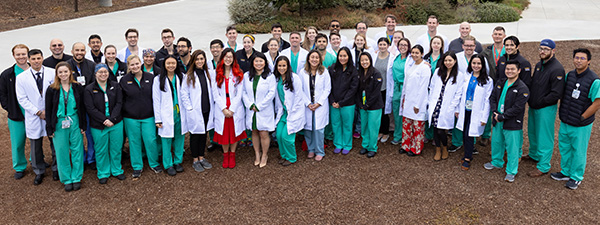
Due to the COVID 19 pandemic, we follow strict prevention guidelines at UC Davis including masking and social distancing. Please note that most pictures on the website were taken prior to the pandemic and do not reflect current institutional guidelines.