Improving Health Through Discovery and Innovation
The research component of the Department of Internal Medicine's mission focuses on two important objectives:
- The keen desire to participate in medical discoveries on a significant scale, and
- The critical need to train the next generation of scientists who will contribute to those breakthroughs.
The department's innovative research program helps to make us unique. Quite simply, we maintain that doctors who teach and conduct research make better physicians, and that the research work we do in the department translates into better patient care.
Translational Research
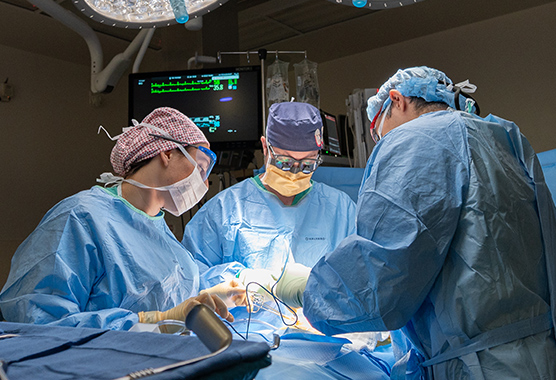
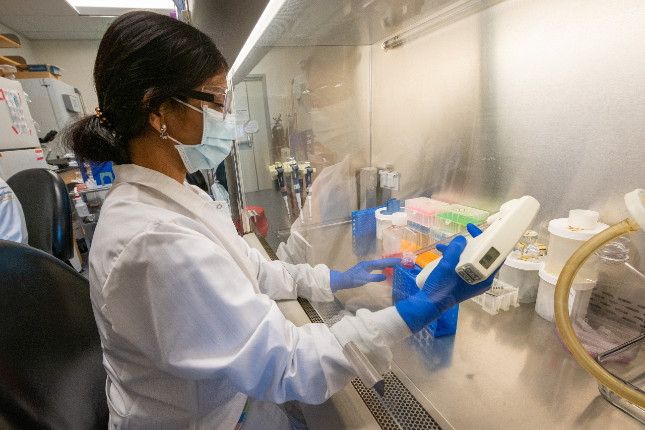
Building translational research goes to the heart of our research program. We believe in taking an interdisciplinary, collaborative team approach in order to share resources and knowledge. Our research activities reflect a wide spectrum that begins with basic medical laboratory research into the mechanisms of disease and how it occurs. Using this data, clinicians are dealing with the impact of disease to apply new therapies and treatments and conduct clinical trials. Meanwhile, department physician scientists orchestrate effective collaboration between researchers and clinicians by translating information and findings to and from the bedside.
UC Davis is the only regional institution to place significant emphasis on translational research, modeling our program on the best practices in medical science nationwide. Our success clearly demonstrates that better patient outcomes can be produced from collaboration between clinicians and researchers who are receptive to the idea of integrating their activities to enhance results.
Clinical Trials
Active Clinical Trials
Clinical trials are detailed protocols involving cutting-edge therapies designed to yield answers and recommendations for new ways of managing and curing disease. Courageous, dedicated patients volunteer to participate in trials with the ultimate hope of cure. Their contributions to the advancement of medicine can have a profound effect on others. Prominent successes have included postoperative therapy for women with breast cancer at high risk for recurrence; new therapy for hypertension, diabetes and osteoporosis; new interventions for heart attack victims; asthma treatment; and many more. An equal number of treatments are rejected as too dangerous or ineffective for broader use. This approach engenders a true respect for evidence-based medicine. Our physicians strive to make health-care decisions based on good science, while treating patients with respect and compassion.
Thus, the department is part of national and regional efforts in drug discovery, testing innovative approaches to illnesses previously unresponsive to treatment. We work with funding from the National Institutes of Health (NIH), the pharmaceutical industry and biotechnology to move quickly from the laboratory to the bedside. However, our clinical research is bidirectional, with our physician scientists providing both new leads for therapy and more accurate predictors of responses to treatment. We want to understand why some patients respond and others do not. This variability from one patient to another presents the essence of our challenge. The laboratory helps augment the clinical characteristics and facilitates understanding of clinical trials results.