Residency Programs
Primary Care Program
UC Davis Internal Medicine has offered a Primary Care (PC) Program dedicated to careers in Primary Care since 1979. Our mission is to train Internal Medicine residents who are passionate and committed to primary care to become physician leaders in primary care, education, advocacy and scholarship. The program accomplishes this goal by offering comprehensive and diverse clinical care experience and didactics. We are committed to recruiting a diverse group of residents who are dedicated to primary care careers and health equity.
Patient Population
UC Davis Medical Center cares for a diverse community, with individuals from a wide range of socioeconomic and geographic backgrounds. Our medical center also accepts the full range of insurance types which gives our trainees unique breadth in clinical learning. By the end of training, beyond working at UC Davis Health, our PC residents will have worked at the VA, Kaiser, community Federally Qualified Health Centers (FQHCs), and specialty clinics.
Each of these clinical experiences exposes our trainees to an even wider range of patients, payor types, and medical conditions. The diversity of clinical care settings and patients gives our residents the experience to feel confident they can practice in any primary care setting they choose.
Postgraduate Year (PGY) 1
The PGY 1 year has a similar structure to the categorical residents, and each intern begins their ambulatory training with a comprehensive 2-week ambulatory immersion. In addition, PC Interns will attend Tuesday morning PC teaching sessions when on outpatient, complete the required nephrology and palliative care electives, and the 2-week Primary Care Elective with the whole PC program.
PGY2 and PGY3 Year
Schedules
As with the residency, we follow an overall 4+4 system.
The PC residents spend more time in the ambulatory setting compared with their categorical colleagues. On average the R2s and R3s spend 16 weeks (vs 10-12 weeks for categorical).
During ambulatory weeks, resident schedules have 2-3 continuity clinics, geriatric longitudinal clinic, and HIV longitudinal clinic. During the week, residents also rotate in core ambulatory medicine subspecialty clinics (see "Clinical Rotations" list below) to enhance their office-based training, non-medicine specialty clinics and have dedicated time for wellness, administrative time, and research and QI projects. See a sample template below.
| Monday | Tuesday | Wednesday | Thursday | Friday | |
| Morning | Subspecialty Clinic or Admin | PC Teaching | Geri Clinic or Continuity Clinic | R2-3 Cohort Conference | Continuity clinic or wellness |
| Lunch | MMQS | PC Morning Report | Morning Report | Grand Rounds | Morning Report |
| Afternoon | Geri Clinic or Subspecialty clinic | Continuity clinic | Continuity clinic | Subspecialty clinic or Research/QI time | HIV longitudinal clinic or Continuity clinic |
Electives
In addition to the ambulatory time, our residents have lots of flexibility to personalize their training through electives . During PGY2 year, each resident has 2 electives plus the Primary Care, Community Based and Addiction elective. The PGY3s have 3 electives plus the Primary Care and Addiction electives.
Every February, residents meet with the program director to identify training goals and residents select their elective experiences based upon their educational needs and career goals. Residents are encouraged to create their own clinic experiences if they are not available. Below are a few of the unique electives our PC residents have priority enrollment in.
Primary Care Elective:
Every February all the primary care residents gather for 2 weeks of didactics, hands on training, advocacy and policy opportunities.
Rural Electives:
The PC residents have opportunities for 2 and 4 week rural primary care rotations at two Northern California sites. Both sites offer strong primary care and addiction medicine clinical experiences. These rotations allow residents to immerse themselves in addiction medicine, rural primary care, subspecialty training that will enhance their training.
Check out this newsletter submission from one of our former residents.
More Rural Experiences:
We will be unrolling a rural track for residents who are committed to future careers in rural communities. Beginning winter 2023, interns can apply. The rural track would include additional education in rural medicine topics and rural clinical rotations during R2 and R3 years. Residents will be able to network with and receive mentorship from physicians practicing in rural communities in California as they consider their own future practice.
Correctional Medicine Elective:
2 week rotation at the Vacaville Correctional Medical Facility. Residents rotate through primary care clinic with longtime correctional medicine primary care physicians and advocates and the hospice clinic. See link.
Clinical Rotations
Here is a list of the clinics our residents rotate at during their ambulatory blocks.
A. Continuity Clinics and Primary Care Program Specialty Clinics:
- Primary Care continuity at UC Davis Health or Sacramento County Health Center: two to three ½ day clinic per week.
- Health Aging Clinic (UC Davis Health): one ½ day clinic per week.
- One Community Health (HIV) Clinic: one ½ day clinic every 2 weeks.
B. Specialty and Subspecialty Clinics:
- Allergy Clinic (UC Davis Health, Mercy Health Care)
- Cardiology Clinic (Sacramento County, UC Davis Health)
- Dermatology Clinic (UC Davis Health, VA)
- Endocrinology Clinic (UC Davis Health)
- Gastroenterology Clinic (UC Davis Health)
- Hematology Clinic (UC Davis Health)
- Hepatology Clinic (UC Davis Health)
- Infectious Diseases Clinic (UC Davis Health)
- Integrative Medicine Clinic (UC Davis Health)
- Medicine-Psychiatry Clinic (UC Davis Health)
- Nephrology Clinic (Sacramento County, UC Davis Health)
- Neurology Clinic (UC Davis Health)
- Oncology Clinic (UC Davis Health)
- Pain Medicine (UC Davis Health)
- Podiatry Clinic (VA)
- Pre-Op Clinic (UC Davis Health)
- Procedure Clinic (Sacramento County)
- Pulmonary Clinic (UC Davis Health, VA)
- Rheumatology Clinic (Sacramento County, UC Davis Health)
- Sports Medicine Clinic (Sacramento County, UC Davis Health)
- Urology Clinic (UC Davis Health)
- Women's Health (Sacramento County, VA)
- Wound Clinic (VA)
C. Inpatient Rotations:
Residents will have 13 blocks of a combination of these rotations over their final two years.
Please visit our Rotations and Schedules page to learn more about the inpatient rotations and outpatient clinics that our residents rotate through.
Primary Care Teaching and Curriculum
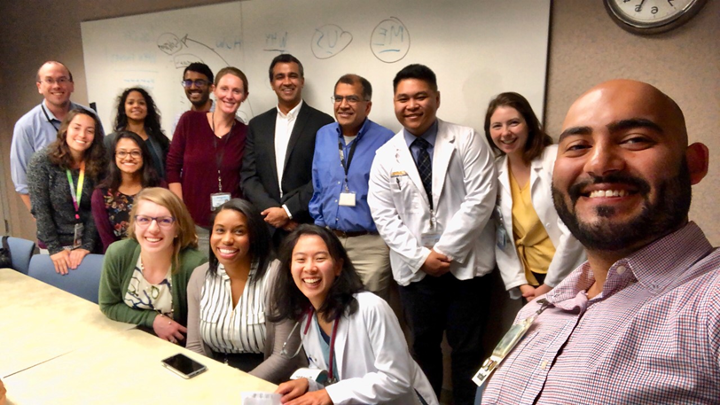
The Primary Care Curriculum is delivered over a two- year period and addresses core topics in primary care. For each topic, we try to integrate updates in primary care guidelines and best practices, journal club articles and a social justice curriculum.
PC and TEACH residents on ambulatory blocks meet every Tuesday morning (8 to 12) for interactive seminars on core primary care topics. This is in addition to the core cohort curriculum every resident attends, grand rounds, MMQS conference, and specialty conferences while on elective.
Key topics covered include:
- Psychiatry in Primary Care
- Focuses on the approach to the diagnosis and treatment of common psychosocial topics pertinent to primary care.
- Medical Interviewing and Communication Skills Seminar
- This seminar series entails reviewing both basic and advanced interviewing skills, including practicing motivational interviewing techniques for common primary care complaints.
- Health Care Policy and Advocacy
- Sacramento is home to our state capital and learning how to be a physician advocate and leader is part of our program curriculum. During your two years, you will develop skills in writing, public speaking and learn to share patients stories to advocate for them to county, city and state level audiences. Each year we participate in Lobby Day.
- Healthcare Disparities
- Sacramento faces many unique health and healthcare disparities. By looking at social determinants of health, and how, as physician leaders, we can combat them we begin to unpack structural barriers to care our patients face. Through local site visits and guest lecturers from local agencies we learn about food insecurity, refugee resettlement, homelessness resources, and harm reduction.
- We also have more in depth lectures on specific populations and risks:
- Food Insecurity
- Geriatrics
- Gun Violence
- Homeless Health
- Incarceration
- Latino Health
- LGBTQI Medicine
- Women's Health
- Outpatient Morning Report
- Our residents are responsible for presenting a case at morning report each Tuesday, focusing on outpatient medicine. This is a great opportunity to take a primary care case and share what you learned with your colleagues.
- Clinical Reasoning/EBM Seminars
- PC residents run these interactive seminars to elucidate the fine points of clinical reasoning, with the help of faculty facilitators.
- Journal Club
- PC Residents critically review articles from the primary care medical literature with their colleagues, applying the basic tenets of Evidence Based Medicine.
Scholarly Work
In addition to the clinical rotations and teaching, each Primary Care Resident is expected to complete a quality improvement project. During PGY2 year, residents will participate in the QI track, where they will learn the fundamentals of QI research. Then working with dedicated QI faculty who are trained to support these research projects, residents will embark on the exciting journey of understanding and solving problems at a clinic or system wide level. The scope and content of the projects are quite variable, and we encourage residents to work together to tackle projects both at the Sacramento County Health Center and at the ACC.
Mentoring
Our primary care residents also have access to a broad network of mentors at UC Davis Health and through our alumni network. As with any path in medicine, mentorship is the key to success and happiness. Our PC alumni practice from Alaska to Los Angeles, in diverse primary care and geriatric practices. We feel fortunate to have our alumni participate in annual mentoring lunches and support our residents as they plan their career paths.
Schedules
Please also refer to the Categorical Program for details on inpatient rotations and the intern year.
The proposed schedules for Primary Care PGY2 and PGY3 years are outlined below. Please note that these numbers are subject to change, depending on a variety of factors.
| Outpatient | 16-18 weeks |
| UC Davis Health/Kaiser/VA Wards | 14 weeks |
| MICU/VA ICU | 2-4 weeks |
| Cardiology Inpatient | 4 weeks |
| ER/Urgent Care | 2 weeks |
| GenMed Consults | 2 weeks |
| Neurology | 2 weeks (R2 only) |
| Elective | 4-6 weeks |
| Vacation | 4 weeks |
Faculty Leadership
Sara Teasdale, M.D. is the Primary Care Program Director and clinician at the Sacramento County Health Center. Clinically in addition to complex medicine care, she is interested in psychiatry in the primary care setting, gender affirming care, and women’s health. She enjoys creating curriculum and ambulatory focused teaching for the residency and primary care program that emphasizes health equity and general internal medicine.
Elora Negose, M.D. is the Assistant Primary Care Program Director and is a primary care physician at the UC Davis Ambulatory Care Center. She is interested in medical education, women’s health, and weight management. She is passionate about fostering an inclusive training environment and mentoring residents at all levels to become excellent clinicians.
Primary Care residents work very closely with UC Davis faculty in a wide range of specialties. Our General Medicine faculty are dedicated clinician-educators, community advocates, diversity leaders, QI researchers, and the majority care for their own primary care panels in the same clinic. They are great clinicians and role-models for doctor-patient relationships.
What About TEACH?
We are often asked, “Can you do the TEACH program if you are in the Primary Care program?”
The answer is a resounding YES.
TEACH is a program for 3rd-year residents only, so many PC residents move over to the TEACH program and add a Sacramento County continuity clinic for their 3rd year.
It adds up to a well-rounded education, with great experiences in PC and geriatrics in the 2nd year, and extensive work with the underserved in the 3rd year.
At least half of our TEACH residents have done the PC program for their first two years.
How To Apply
Both our Categorical and Primary Care programs have separate numbers in the National Residency Match Program, and both programs are listed on ERAS.
If you are interested in either, or both, you just select it when applying through ERAS. You are free to rank both programs in the Match, but we use ERAS to determine if we should list you.
Information on how to apply
Applicants who are certain that they want to do primary care should list the PC program first in their match list. They should also list the Categorical program, as we often have residents join the PC program via the application during the intern year. Applicants who are uncertain about a primary care career can join the Categorical program. By November of their intern year, they likely will have a better idea about if they want to do primary care. If so, they can apply for the remaining primary care slots. We usually have space to accommodate all that apply in their internship.
The applications for the slots to be filled from our active interns are sent out in November, and final selection takes place in late January each year. Preference is given to those residents interested in pursuing primary care internal medicine as a career, or those who plan to do subspecialty training in fields that involve significant ambulatory practice.
Primary Care Graduates
Visit our 'Life After Residency' page to see where past Primary Care residents have gone after graduating.
Contact Us
Any questions about the Primary Care Internal Medicine Residency Program can be directed to the Primary Care Program Director, Dr. Sara Teasdale, at srteasdale@ucdavis.edu or Primary Care Associate Program Director, Dr. Elora Negose, at enegose@ucdavis.edu.