



Surgery for esophageal cancer
The UC Davis Comprehensive Cancer Center offers multidisciplinary care for patients with all stages of esophageal cancer aimed at cure or control of disease, prevention of cancer recurrence and optimization of quality of life. Your team of cancer specialists will include experts in general thoracic surgery, gastroenterology, radiation oncology, diagnostic and interventional radiology, nutritional services and medical oncology.
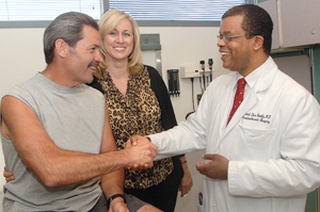 Esophageal cancer forms in tissues lining the esophagus, the muscular tube through which food passes from the throat to the stomach. There are two types of esophageal cancer, which are diagnosed and managed in similar ways:
- Squamous cell carcinoma: This begins in flat cells lining the esophagus, usually in the upper part of the esophagus.
- Adenocarcinoma: This begins in cells that make and release mucus and other fluids, and is usually found in the lower part of the esophagus. Adenocarcinoma is the most common esophageal cancer.
The UC Davis Health System team uses a variety of surgical therapies to treat esophageal cancer as well as benign esophageal diseases. Benign diseases of the esophagus that may require surgical treatment include achalasia, paraesophageal hernia, esophageal diverticulum, esophageal perforation and benign esophageal tumors such as leiomyoma.
Surgery, either alone or together with chemotherapy and/or radiation therapy, can be curative for esophageal cancer. Specific surgical procedures may include:
Esophagectomy, or removal of the esophagus. This is an advanced intervention for patients with a non-functioning esophagus or esophageal cancer. Esophagectomy is performed to reestablish intestinal continuity so patients can again swallow food comfortably. There are several types of esophagectomy; UC Davis surgeons will decide on the best option based on the disease process of the individual patient. Types of esophagectomy include but are not limited to:
- Transhiatal esophagectomy. Transhiatal means without cutting through the chest. This less-invasive technique allows the esophagus to be removed, and the stomach attached to the remaining portion of esophagus in the neck, without entering the patient’s chest. Because the chest is not opened, the operation is usually shorter, and the patient may experience less pain during recovery, a quicker healing period and shorter hospital stay.
- Transthoracic esophagectomy. A transthoracic procedure goes through the open chest. It is more invasive, but allows for a direct visualization of the esophagus during the surgery, which facilitates mobilization of the esophagus for post-operative healing.
Many esophagectomy surgeries can be done with a combination of minimally invasive and video-assisted techniques. One of the most important determinants of a patient’s successful outcome after esophagectomy is post-operative recovery. UC Davis employees a detailed esophagectomy post-operative pathway and recovery regimen and a highly skilled nursing team trained in swiftly identifying and managing potential postoperative complications. In addition, UC Davis has the highest ranking for esophageal resection by the LeapFrog Group for Patient Safety.
Cooke DT, Lin GC, Lau CL, Zhang L, Si MS, Lee J, Chang AC, Pickens A, Orringer MB. Analysis of cervical esophagogastric anastomotic leaks after transhiatal esophagectomy: Risk factors, presentation, detection. Annals of Thoracic Surgery. 2009 July; 88(1):177-85.
MORE »
Cooke DT, Calhoun RF. Distance alone does not define the value of the posterior mediastinal route for esophageal reconstruction. Letter to the editor. Annals of Thoracic Surgery. 2009 0ct; 88(4):1390.
MORE »
Cooke DT, Lau CL. Primary repair of esophageal perforation. Operative Techniques in Thoracic and Cardiovascular Surgery. 2008;13(2):126-137.
MORE »
Oncologists Specializing in Esophageal Cancer
Surgical Oncology / Thoracic
 David Tom Cooke, M.D., F.A.C.S.
Associate Professor of Clinical Surgery
Head, Section of General Thoracic Surgery
 Lisa M. Brown, M.D., M.A.S., F.A.C.S.
Assistant Professor of Thoracic Surgery
Division of General Thoracic Surgery
 Luis Godoy, M.D.
Assistant Professor of Thoracic Surgery
Division of Thoracic Surgery
Thoracic Surgery Nurse Coordinator
Valerie Kuderer, R.N.
Physician Assistants
Jessica Harvey-Taylor, PA-C
Felicia Tanner-Corbett, PA-C
Contact Us:
Physician to Physician Referrals
1-800-4-UCDAVIS (1-800-482-3284)
General Thoracic Surgery Direct Clinical Line (Monday - Friday, 8 a.m. to 4:30 p.m.)
916-734-5994
Email (non-urgent): thoracic.surgery@ucdmc.ucdavis.edu
Social Media:
Twitter: Twitter@UCD_ChestHealth
Diagnostic Radiology
 John P. McGahan, M.D.
Professor of Radiology
Chief of Abdominal Imaging and Ultrasound
Gastroenterology
 Joseph W. Leung, M.D.
Professor of Medicine
Chief of Gastroenterology
 Shiro Urayama, M.D.
Professor of Medicine, Gastroenterology
Hematology and Oncology
 Edward Kim, M.D., Ph.D.
Associate Professor of Internal Medicine, Hematology and Oncology
 Kit Tam, M.D.
Assistant Professor of Internal Medicine, Hematology and Oncology
Radiation Oncology
 Ruben Fragoso, M.D., Ph.D.
Assistant Professor
 Arta Monjazeb, M.D., Ph.D.
Assistant Professor
Dietitians
 Danielle Baham, M.S., R.D.
 Kathleen Newman, R.D., C.S.O.
Genetic Counselors

 Nicole Mans, M.S., L.C.G.C.
 Jeanna Welborn, M.D.
Social Workers
 Sara Chavez, L.C.S.W., O.S.W.-C., A.C.H.P.-S.W.
 Sarah Conning, L.C.S.W., O.S.W.-C.